

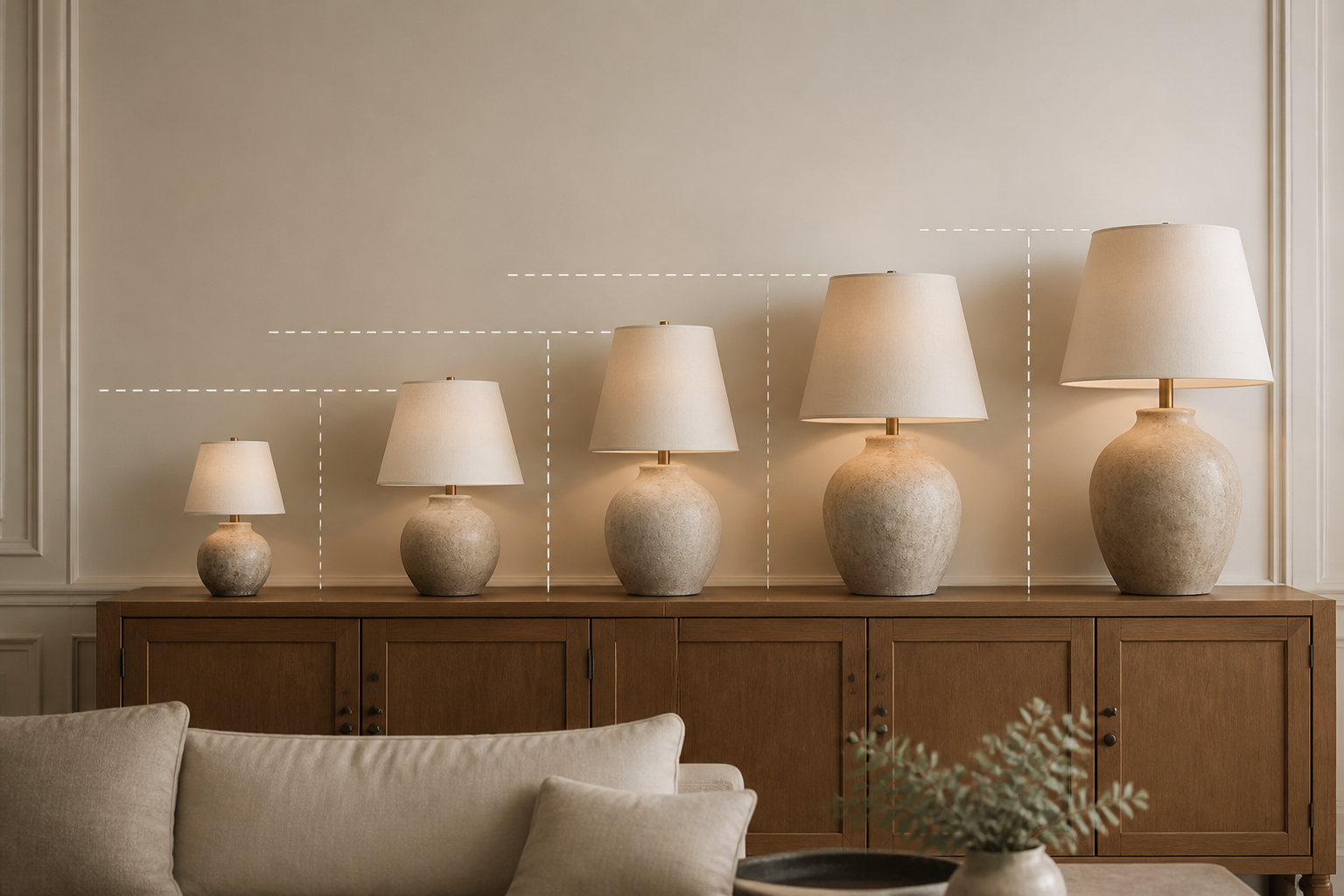
table lamp sizing guide: easy formulas for bedsides, sofas, and desks
If a lamp looks off, it usually isn’t the style—it’s the size. This table lamp sizing guide gives you clear formulas, visual rules of thumb, and room-by-room tips so your lamps feel intentional, balanced, and comfortable to use.
How to measure your space
Before you shop, gather a few quick measurements. These numbers determine the lamp height, shade width, and how the light lands where you need it.
- Surface height: The top of the nightstand, end table, console, or desk.
- Seating height: The height from the floor to the seat cushion where a person’s eyes will be when using the lamp for reading or conversation.
- Eye level: Seated eye height is typically 40–44 inches from the floor for many adults. Use your own measurement for accuracy.
- Clearance: Distance from lamp base center to nearby walls, art, or objects to avoid cramped layouts or glare.
- Room context: Ceiling height and furniture scale (slim vs. bulky) help fine-tune lamp proportions and shade size.
Proportion and placement rules that always help
Use these evergreen guidelines to get 90% of the way there, then adjust for comfort and style.
- Lamp height target: Aim for the center of the bulb (or the lower edge of the shade) to sit near seated eye level when used for reading or ambient light.
- Shade width: A classic starting point is a shade roughly equal to the visual width of the base at its widest point, or about 1.5–2x the base diameter for drum shades. Oversizing the shade slightly can look modern and improve diffusion.
- Shade shape: Drum shades throw light evenly; empire shades push more light downward; tapered rectangles save space on narrow surfaces.
- Harp and finial: Use harp height to fine-tune where the shade sits. A taller harp lifts the shade and reveals more bulb; a shorter harp lowers it to reduce glare.
- Glare control: Ideally, the bottom of the shade hovers near eye level when seated so you don’t see the bulb directly.
- Weight and stability: Heavy bases resist tipping, especially on high-traffic tables or narrow consoles.
- Balance with furniture: If your furniture has chunky arms or thick tops, scale up lamp body and shade. With slim, minimal profiles, a leaner lamp reads cleaner.
Sizing by room and function
Different tasks call for slightly different targets. Use the formulas below and tweak around them for your exact seat height and table dimensions.
Bedside nightstands
- Start here: Lamp height (including shade) usually falls between 24–28 inches on standard-height nightstands.
- Eye-level rule: When you’re sitting up in bed, the bottom of the shade should be close to your eye level to reduce glare.
- Formula: Lamp height ≈ mattress top height + 2–6 inches difference once placed on the nightstand so the shade’s lower edge aligns near your eyes.
- Shade footprint: Keep the shade inside the tabletop boundary. For 18–22 inch wide nightstands, look for shade widths around 12–16 inches.
- Switch reach: Test that you can reach the switch while seated without leaning far.
Living room end tables next to sofas or chairs
- Seat reference: Measure seat height. Most sofas/chairs fall around 17–20 inches to the cushion top.
- Height target: The lower edge of the shade should sit around seated eye level (often 40–44 inches from the floor), which typically yields total lamp heights of 26–30 inches depending on the table height.
- Proportion tip: If your end table is substantial (thick top, storage), consider a bolder lamp silhouette with a 14–18 inch wide shade to hold visual weight.
- Conversation lighting: Choose diffused shades that soften faces and prevent harsh shadows.
Console tables and entryways
- Surface heights: Consoles usually range 30–34 inches high.
- Height target: Total lamp height commonly lands between 28–34 inches to add presence against a wall and art without overwhelming the vignette.
- Pairs or symmetry: Two lamps flanking art or a mirror look balanced; keep their shade bottoms aligned and leave a comfortable gap from frames.
- Shade shape: Ovals or rectangles can save depth in tight hallways, avoiding traffic bumps.
Desks and work surfaces
- Task clarity: The light source should sit just above your natural line of sight onto the work area.
- Adjustability: If you prefer table lamps to task arms, pick a medium-height lamp (24–28 inches) with a directional or opaque shade to cut screen glare.
- Handedness: Place the lamp on the opposite side of your writing hand to reduce shadows.
Dialing in shade size, harp height, and bulbs
Fine-tuning separates “looks okay” from “looks designed.” Here’s how to calibrate the last 10%.
Shade diameter and shape
- Drum shades: Modern and versatile. Try a diameter 1.5–2x the base diameter. If the base is 6 inches wide, a 10–12 inch drum often balances.
- Empire shades: Traditional downward spread. Great for reading on narrower tables where you want focused light.
- Oval/rectangular shades: Ideal for shallow surfaces; choose longer front-to-back for diffusion without protruding.
Shade height
- Classic proportion: Shade height about 60–70% of its diameter for drums is a steady starting point; adjust to taste.
- Lower vs. higher: A lower shade hides bulbs better (less glare) but can reduce light spread. Taller shades raise the visual center, helpful on chunky bases.
Harp and finial adjustments
- Raise the shade: Use a taller harp to reveal more bulb for brighter diffusion (watch glare).
- Lower the shade: A shorter harp conceals the bulb and trims glare—useful for eye-level seating zones.
- Check the neck: The shade should cover the socket and most of the neck for a finished look.
Bulbs and brightness
- Ambient living rooms: 400–800 lumens per lamp is a flexible range, layered with other lights.
- Reading: Aim higher (600–900 lumens) with warmer color temperatures if you prefer cozy tone; neutral whites help focus.
- Glare control: Frosted or soft-white bulbs reduce hotspots in clear glass or high-cut shades.
- Heat and safety: Match lamp and shade ratings; high-heat bulbs can discolor delicate materials. Follow manufacturer limits on wattage.
Quick formulas you can trust
- Seated-eye alignment: Shade bottom ≈ seated eye level (often 40–44 inches from floor). Adjust with harp height.
- Bedside ballpark: Total lamp height ≈ 24–28 inches (verify against your mattress height while seated).
- Sofa side table: Lamp height often ≈ 26–30 inches, tuned so shade bottom meets eye level.
- Shade width: Start near base width or 1.5–2x base diameter for drums; ensure shade stays within tabletop edges.
- Two-lamp symmetry: Keep shade bottoms even and leave at least a hand’s width from adjacent art or mirrors.
Common scenarios solved
“My lamp looks tiny on a big end table.”
- Increase vertical presence: Choose a taller lamp or swap to a larger shade using a taller harp.
- Wider stance: Drum shades at 14–18 inches across add visual weight without changing the base.
- Layer the vignette: Stack a couple of books under the lamp base for height (and character) if safe and stable.
“The bulb glares when I sit down.”
- Lower the shade: Try a shorter harp or a slightly taller shade to lower the bottom edge.
- Change the bulb: Use frosted bulbs and/or lower lumen output if brightness, not placement, is the issue.
- Shift position: Move the lamp back a few inches on the table to change the sightline.
“Two lamps look mismatched in height.”
- Match shade bottoms: Even if the lamps differ in total height, equalize the shade bottoms for symmetry.
- Use risers: Subtly lift the shorter lamp with a book stack or low plinth that suits the style.
- Swap harps or finials: Small hardware changes can equalize shade positions.
“The shade keeps bumping the wall in my hallway.”
- Change shape: Oval or rectangular shades reduce depth while maintaining width.
- Slide forward: Bring the lamp slightly forward on the console to clear the wall; ensure cord safety.
- Downsize the shade: A one-step smaller diameter may solve clearance without losing proportion.
Styling with scale: make it look intentional
Once you have the right size, finish the scene so the lamp feels integrated instead of floating.
- Vary heights: A low bowl, medium book stack, and your lamp create a pleasing skyline across a console.
- Echo shapes: Pair a drum shade with round trays or vases; couple an angular shade with linear picture frames.
- Mind negative space: Leave breathing room on both sides of the lamp so the surface doesn’t look crowded.
- Coordinate materials: Repeat a metal or wood tone from the lamp in a nearby object to tie the vignette together.
Step-by-step sizing walkthrough
- Sit where you’ll use the lamp and measure eye height from floor.
- Measure table height and width/depth.
- Choose a lamp height that lets the shade bottom meet your seated eye level once on the table.
- Select a shade width that stays inside the tabletop edges, starting near the base width or 1.5–2x base diameter for drums.
- Adjust harp height to fine-tune glare and visual balance.
- Test with your actual bulb and switch type; check reach and cord route.
FAQ
What size table lamp is best for a small nightstand?
Keep the shade inside the tabletop edges. On 18–20 inch wide nightstands, many people land near 24–26 inch tall lamps with 12–14 inch drum shades. Verify by sitting up in bed: the shade’s bottom edge should be near your eye level.
Should my table lamp be taller than my headboard?
It doesn’t have to be. Use eye-level alignment first. If your headboard is especially tall, you can scale up the lamp to maintain visual presence, but prioritize glare-free reading over strictly clearing the headboard top.
How do I match two lamps on a console with a mirror in the middle?
Align the shade bottoms at the same height and keep a comfortable gap from the mirror frame—typically at least a hand’s width. Choose shades that don’t project so far forward that they hit the wall or dominate the surface.
What bulb type reduces glare the most in a clear-glass lamp?
Frosted or soft-white bulbs diffuse hotspots better than clear bulbs. You can also lower the shade slightly with a shorter harp or use an opal glass inner diffuser where compatible.
How do I size a lamp for a deep sectional with high arms?
Scale up both height and shade width so the lamp doesn’t feel dwarfed. Many high-armed sectionals pair well with 27–31 inch lamps and 15–18 inch shades, tuned so the shade bottom meets seated eye level.