

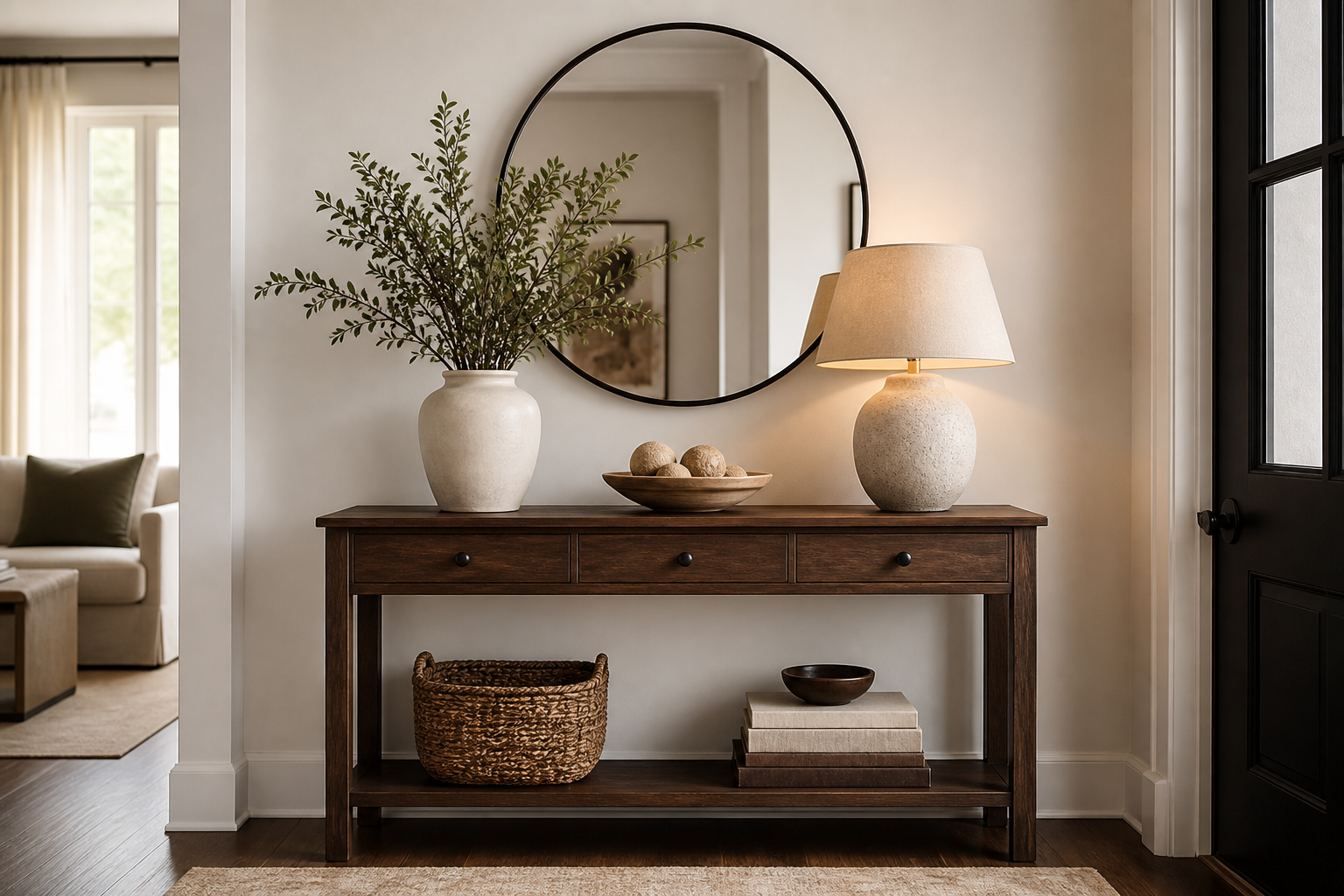
Console table decorating ideas that balance style and function
Console tables do a lot of quiet heavy lifting in a home. They greet guests in the entry, anchor a sofa in the living room, and make narrow hallways feel considered. Done well, they deliver personality, storage, and a polished first impression—all in just a few feet of depth. These console table decorating ideas will help you compose arrangements that look effortless, stay practical, and adapt across seasons.
Choose the right console table proportions
Great styling starts before the first accessory: with scale. When the table’s size suits the wall, mirror or art, and nearby furniture, everything else falls into place.
- Length: Aim for a console that fills 60–80% of the wall span it sits on. Behind a sofa, choose a console that’s slightly shorter than the sofa width for a tailored look.
- Height: In entries and living rooms, 30–34 inches tall is common. When placed behind a sofa, keep the console height near the sofa back height to avoid awkward ledges.
- Depth: Shallow tables (10–16 inches) suit hallways and tight entries; deeper consoles (up to ~18 inches) work behind sofas or on larger walls.
- Clearance: Give at least 36 inches of walkway space in busy areas so decorative pieces won’t get bumped.
Tip: If you already own a console that’s a bit short or narrow for the wall, visually expand it with a wide piece of art or an overscale mirror to restore balance.
Anchor with art or a mirror
An anchor on the wall turns a console vignette into a composition. It adds height, draws the eye, and defines the centerline you’ll style around.
- Single statement piece: One large artwork or mirror centered above the console is simple and striking. Leave a few inches between the table surface and the bottom of the piece so the arrangement can breathe.
- Gallery grid: A tidy grid of smaller frames can echo a modern, structured vibe. Keep spacing consistent and align the grid’s midpoint with the console’s midpoint.
- Leaned layers: For a relaxed look, lean a large frame on the console and layer a smaller piece in front. This works especially well if you like to swap art seasonally.
Mirrors earn extra credit in entries by bouncing light and offering a last-look check on the way out the door. Artwork, on the other hand, sets tone and mood—consider color, scale, and subject to complement your overall scheme.
Layer lighting for depth
Lighting turns a row of objects into a scene. It adds height, warmth, and sculptural interest, and it helps a console function after dark.
- Symmetry with two lamps: Place matching table lamps at both ends to frame the display. This is ideal for larger consoles or when you want a crisp, formal feel.
- Asymmetry with one lamp: Use a single lamp on one side and balance the other with a tall vase, branch arrangement, or stacked books to keep energies equal.
- Alternative light sources: A slim sconce or a low-profile picture light above the art can free surface space while spotlighting the vignette.
Choose lamp shades that don’t overwhelm the depth of a narrow console. Drum or tapered shades with a modest footprint help maintain clear walkways.
Style with trays, bowls, and books
Flat surfaces love structure. Trays, bowls, and books organize small essentials and create “zones” so your display reads as intentional rather than scattered.
- Entry catchall: A shallow tray or lidded box corrals keys and earbuds. Pair with a compact bowl for coins and a slender vase to lift the eye.
- Stacked books: Two or three coffee table books make a low pedestal for a candle, small sculpture, or a decorative object. Vary book sizes to avoid a blocky look.
- Layered heights: Combine a low tray, a medium-height object (like a candle), and one taller piece (like branches) to create a balanced visual triangle.
When color-coordinating, echo hues from your art or rug so the console looks rooted in the room rather than floating as its own island.
Add height with vases and branches
Every successful console composition has at least one vertical element. Vases with branches or tall dried stems punctuate the arrangement and give it architecture.
- Scale check: The tallest element should usually sit roughly one-half to two-thirds the height of the wall anchor (art or mirror). This keeps the eye moving without blocking the focal point.
- Organic shapes: Branches, pampas, or sculptural greenery soften straight console edges and frame the arrangement naturally.
- Pairing vases: Two vases of different heights on the same side create a gentle cascade of forms; use similar materials or tones for cohesion.
If you prefer a minimal look, a single oversized vessel with just a few stems can do the heavy lifting and leave the rest of the surface calm.
Integrate storage with style
Consoles often help with daily flow, so make hidden or semi-hidden storage part of the plan. The key is to keep functional pieces consistent with the design language of your display.
- Under-console baskets: Tuck a pair of lidded baskets beneath an open-base console for shoes, scarves, remote blankets, or toys.
- Boxes on top: A handsome box or two on the surface hides small items you reach for often. Stack boxes to vary height.
- Drawer etiquette: If your console has drawers, dedicate one to grab-and-go items and one to stationery, chargers, or mail to reduce surface clutter.
Match basket texture to your room’s palette—woven fibers for warmth, canvas for utility, or sleek bins for a contemporary edge.
Seasonal and occasional switch-ups
Because a console’s footprint is small, it’s one of the easiest places to refresh your home’s look. Keep a short list of swap-friendly elements and rotate them through the year.
- Spring: Light branches, citrus-hued candles, and airy ceramics.
- Summer: Coastal textures, a shell dish, or a bowl of fresh greenery.
- Fall: Amber glass, dried seed pods, and earth-toned books.
- Winter: Metallic accents, evergreen clippings, and layered candlelight.
For special occasions, add a small framed photo, a festive garland draped along the back edge, or a themed catchall that still feels true to your palette.
Console styling formulas to try
Use these simple recipes when you want a foolproof starting point. Each balances height, volume, and negative space so the surface never feels crowded.
- The balanced bookend: Two lamps at the ends + centered art/mirror + low tray with a candle and match striker. Minimal, bright, and symmetrical.
- The asymmetrical trio: One lamp on the left + tall vase with branches on the right + books and a small object in the middle. Dynamic and modern.
- The soft layer: Leaned oversize art + single sculptural vase + stacked books with a small bowl on top. Relaxed and textural.
- The family hub: Mirror + shallow tray for keys and mail + lidded box + under-console baskets. Practical without reading “storage first.”
- The art-forward stack: Gallery grid above + slim picture light + a linear row of objects (books, low bowls, a candle) for a gallery-like effect.
Common mistakes and how to fix them
Most console missteps trace back to scale, clutter, and lighting. Here’s how to troubleshoot quickly.
- Everything is short: Add one tall element—branches, a tall lamp, or a stacked set of books—to break the horizon line.
- It feels busy: Create zones with a tray, remove one item from each cluster, and introduce more negative space between objects.
- The art looks cramped: Raise the piece or swap to a larger frame so the anchor feels proportional to the console width.
- Shadows or glare: Use a lamp with a diffusing shade, reposition the light, or try a picture light to illuminate art without hot spots.
- Awkward walkway: Choose shallower pieces, center the console on the wall, and ensure lamp shades don’t jut into traffic paths.
Room-by-room ideas
The best console table decorating ideas flex to different spaces. Tailor these setups to the job each room needs to do.
- Entryway: Mirror + tray for keys + box for sunglasses + umbrella stand beside the console. If space allows, add a small stool tucked beneath for putting on shoes.
- Living room: Art + one lamp + a sculptural object + a bowl for remotes. Run a cord discreetly behind the table to power a lamp without visual clutter.
- Dining area: Console as sideboard—lamp pairs + a low runner-length tray for decanters or candles. Keep the center clear for staging dishes during gatherings.
- Hallway: Shallow console + leaned art + a single narrow lamp. Keep accessories slim so the walkway stays generous.
- Bedroom: Use a console as a vanity with a mirror, small organizer, and a soft, armless chair slid underneath when not in use.
Materials and finishes that play well
Mixing materials keeps a console vignette from feeling one-note. The trick is to repeat a finish or color at least twice so the eye reads intention.
- Wood + metal: Warm wood consoles pair beautifully with metal picture frames or a metal lamp base. Repeat each finish somewhere else in the scene.
- Stone or concrete: Heavier surfaces like stone appreciate lighter accessories—clear glass vases, open-wire bowls, or airy branches.
- Rattan or cane: Woven textures bring warmth. Balance with smooth ceramics and crisp books to keep the look elevated rather than rustic.
- Glass: A glass-top console benefits from substantial objects (like stacked books or a solid vase) so the arrangement doesn’t feel weightless.
Quick measure cheat sheet
These are general, forgiving ranges—the right answer depends on your room, objects, and personal taste. Use them as a starting point, then adjust by eye.
- Gap between console top and bottom of art/mirror: 4–10 inches.
- Width of art/mirror relative to console: about 60–80% of console width for a single piece.
- Lamp shade diameter on narrow consoles: often 10–14 inches to keep traffic paths clear.
- Object groupings: clusters of 3 or 5 read intentional; let each cluster have a low, medium, and tall element.
FAQ
How high should I hang a mirror above a console table?
Leave a small visual break—typically 4–10 inches—between the console surface and the bottom of the mirror. If your console is taller than average, lean the mirror or aim for the lower end of that range to keep the composition connected.
What should I put under an open-base console?
Pairs of baskets keep the silhouette calm while adding storage for shoes, scarves, throws, or toys. For a lighter look, a single sculptural stool or bench can fill the negative space without feeling heavy.
How do I keep an entry console from getting cluttered?
Define a catchall zone with a tray or box and limit daily-drop items to that spot. Edit accessories to two or three clusters, and give each cluster breathing room. A weekly reset—returning stray mail or sunglasses to drawers or baskets—keeps the surface camera-ready.
Do I need two lamps, or is one enough?
Use two lamps when you want symmetry or have a wide console to illuminate. One lamp creates an asymmetrical look that’s modern and relaxed. Whichever you choose, balance the opposite side with a tall object so the arrangement feels deliberate.
What’s the best way to mix colors on a console?
Choose one or two anchor hues from nearby art, a rug, or upholstery. Repeat those colors at least twice in the vignette—through books, ceramics, or florals—so the palette feels cohesive rather than random.